In brief: best-practice clinical supply forecasting means modelling uncertainty rather than hiding it, comparing scenarios rather than relying on a single plan, balancing supply assurance against waste and cost, reforecasting quickly when circumstances change, and using real study data to continuously improve the plan.
Clinical supply forecasting can be a difficult job.
Supply planners have to translate a clinical protocol and a series of assumptions about patient recruitment and behaviour into decisions about manufacturing, packaging, inventory and distribution, often months before actual demand is known.
And the forecast has to remain useful as those assumptions inevitably change.
The strongest clinical supply teams therefore don't necessarily distinguish themselves by producing a more detailed initial forecast. They distinguish themselves by how they use forecasting to make decisions throughout the life of a study.
Based on our experience, five areas of best practice stand out.
1. Build uncertainty into the forecast from the beginning
Every clinical supply forecast starts with assumptions.
Recruitment rates, site activation dates, country mix, screening failure, dropout, treatment duration, titration rates and dosing all influence demand. Yet none of them is completely predictable.
Best-practice forecasting recognises this uncertainty rather than disguising it behind a single baseline number.
A baseline forecast remains important, but it becomes the starting point rather than the answer.
Teams should be able to explore questions such as:
What if recruitment is 20% faster or slower?
What happens if several large sites activate late?
What if dropout is lower than expected?
What happens if one country contributes significantly more patients than planned?
How does a change in shelf life affect usable inventory?
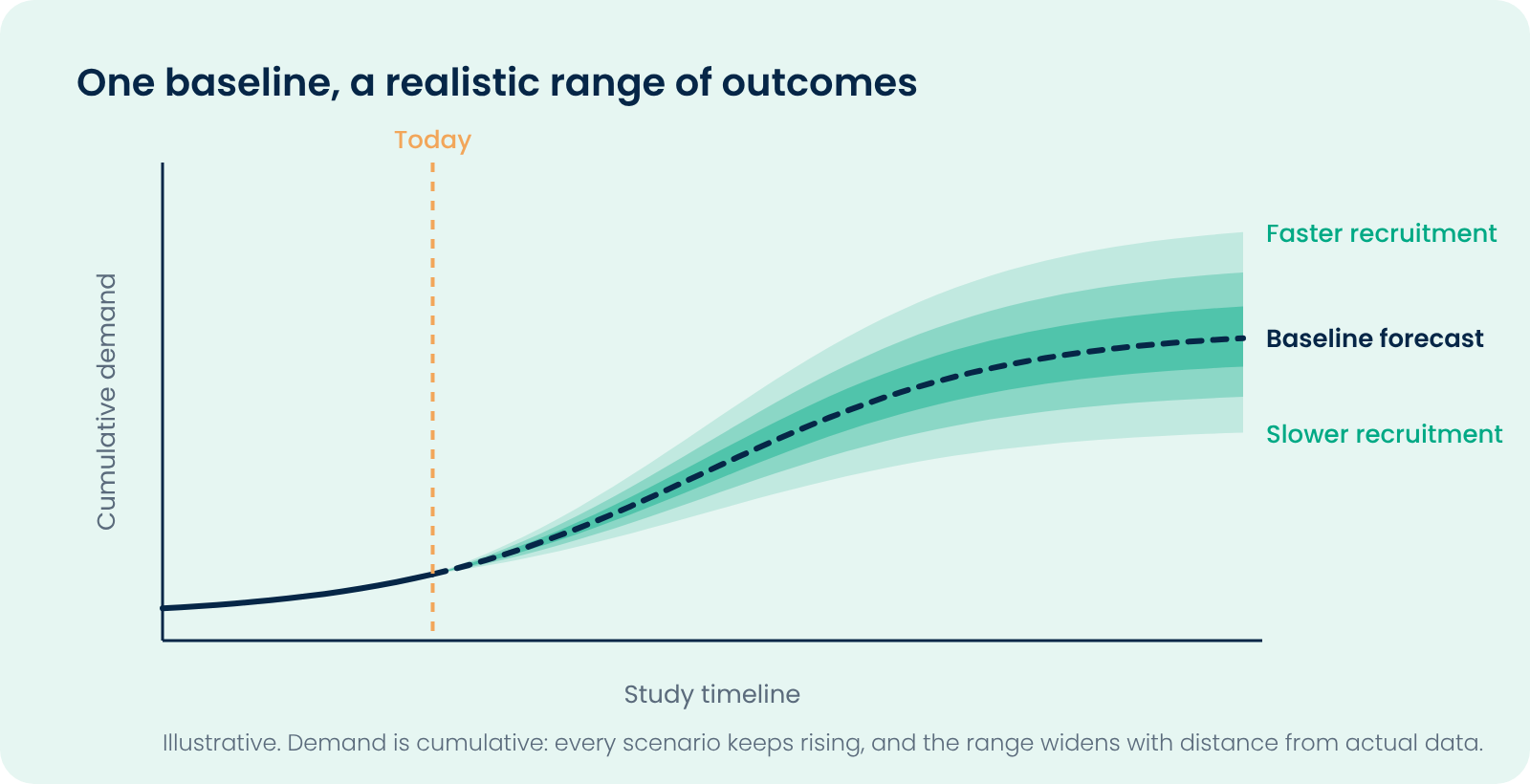
This creates a fundamentally different conversation.
Instead of asking "Is the forecast right?", the supply team can ask:
"Across the realistic outcomes for this study, where are we exposed and what can we do about it?"
That is a much more valuable question.
2. Use scenario planning as part of routine decision-making
Scenario modelling is sometimes treated as an exceptional exercise, something undertaken when recruitment falls significantly behind plan or a supply issue has already materialised.
Best practice is to make it part of normal planning.
This becomes particularly important when a team is considering a material change to the study.
For example, imagine recruitment is behind target and Clinical Operations proposes opening additional countries.
The supply question isn't simply whether those countries could recruit more patients.
Different options could affect:
packaging requirements;
country-specific labels and translations;
regulatory timelines;
available inventory;
depot requirements;
expiry exposure;
shipment volumes; and
manufacturing requirements.
Recent Trialzen work on clinical supply resilience specifically explores this type of situation, including whether existing inventory can support a change, whether stock can be relabelled, whether additional supply is required, and how country choice affects the outcome.
Rather than deciding on an operational strategy and then forecasting its impact, model the alternatives first and allow the forecast to inform the decision.
3. Balance availability, risk, waste and cost
Ensuring that the right medication is available for every patient is non-negotiable.
But simply increasing inventory everywhere isn't sophisticated risk management.
Best-practice planning attempts to understand where additional inventory actually reduces risk and where it simply creates additional cost and waste.
That requires looking beyond the headline quantity of drug available.
Where is the inventory?
When will it expire?
When will replacement stock become available?
How quickly can it be replenished?
How much of it can realistically be used by the study?
What happens under different recruitment scenarios?
This makes overage a planning decision rather than simply a standard percentage added to the forecast.
The goal should be to find the appropriate balance between:
Patient protection | Supply continuity | Inventory | Waste | Cost
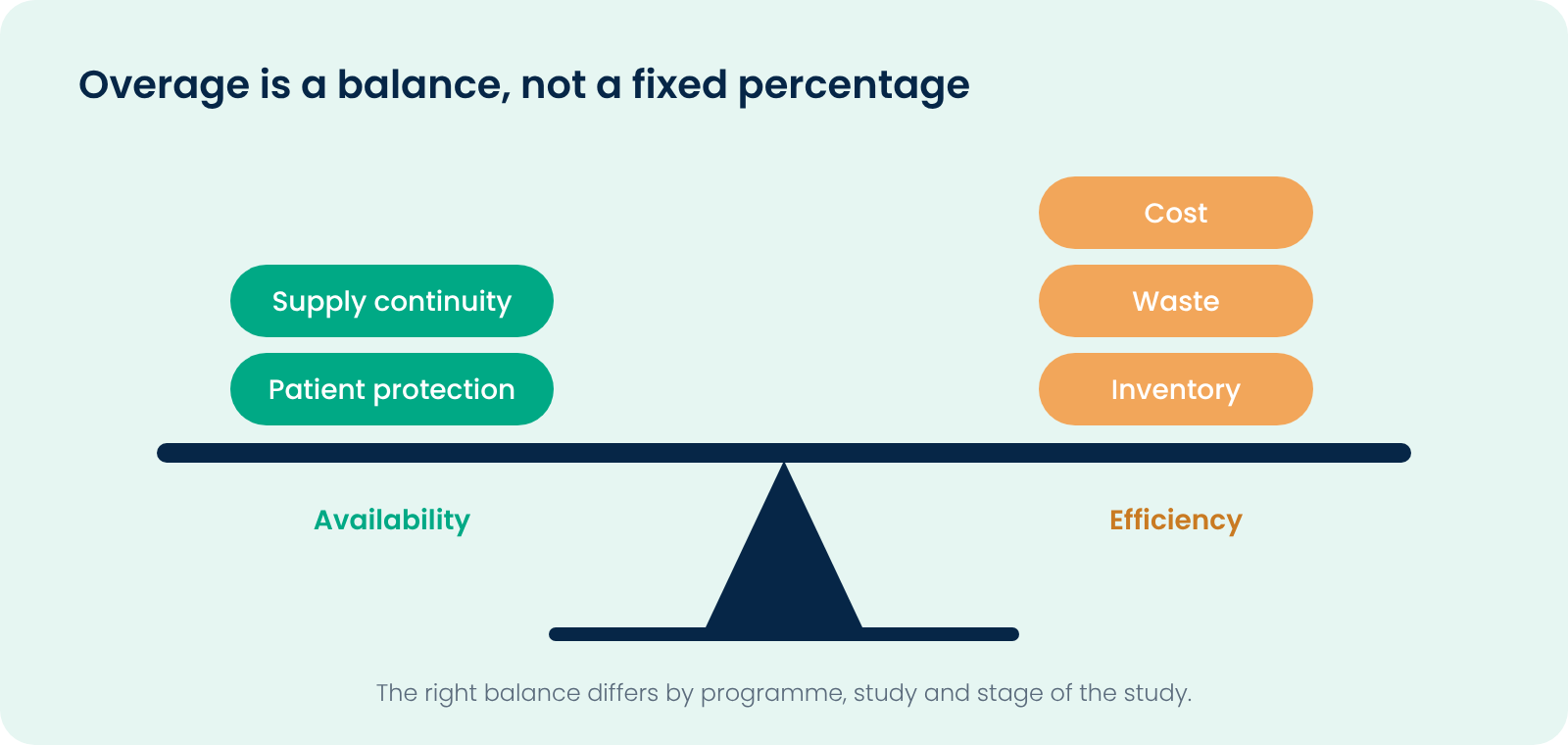
Importantly, that balance won't necessarily be the same for every programme, study or stage of a study.
Early in a trial, uncertainty may justify greater protection. As real recruitment and consumption data become available, that uncertainty should reduce and the supply strategy should be capable of changing with it.
4. Reforecast quickly when reality changes
A forecast has its greatest value when it can influence a decision.
That means speed matters.
Clinical trials rarely progress precisely according to their original assumptions. Recruitment changes. Sites open late. New countries are added. Protocols are amended. Expiry dates move. Manufacturing plans change.
A forecasting process that takes days or weeks to evaluate the effect of those changes creates a practical problem: by the time the analysis is complete, some of the available options may have disappeared.
Best-practice forecasting therefore isn't only about sophistication. It is also about responsiveness.
Teams should be able to take new information and rapidly understand:
What has changed?
What does it do to projected demand?
Where does it create supply risk?
What options do we have?
What are the cost and risk implications of each option?
This is increasingly important as forecasting connects with wider manufacturing and enterprise planning.
A highly sophisticated model is needed, but if it takes two weeks and a PhD to complete an update, it may well be too costly and too late to utilise for fast operational decisions. That’s why Trialzen FPS is specifically designed as an easy-to-use, self-service system that seamlessly integrates RTSM data allowing the team to evaluate meaningful alternatives while the decision can still be influenced.
5. Connect the forecast to real study data
Perhaps the biggest opportunity is to stop treating forecasting as a standalone planning activity.
As a study progresses, assumptions should increasingly give way to reality.
Actual recruitment, randomisation, dispensing and inventory information provides evidence about how the study is really behaving. That information should continuously improve the team's understanding of future demand.
This is particularly relevant to the relationship between forecasting and RTSM/IRT.
Rather than maintaining two separate worlds, one describing what planners expect to happen and another recording what is happening, best practice is to bring the two closer together.
The principle is simple:
Plan → Observe → Reforecast → Evaluate → Act
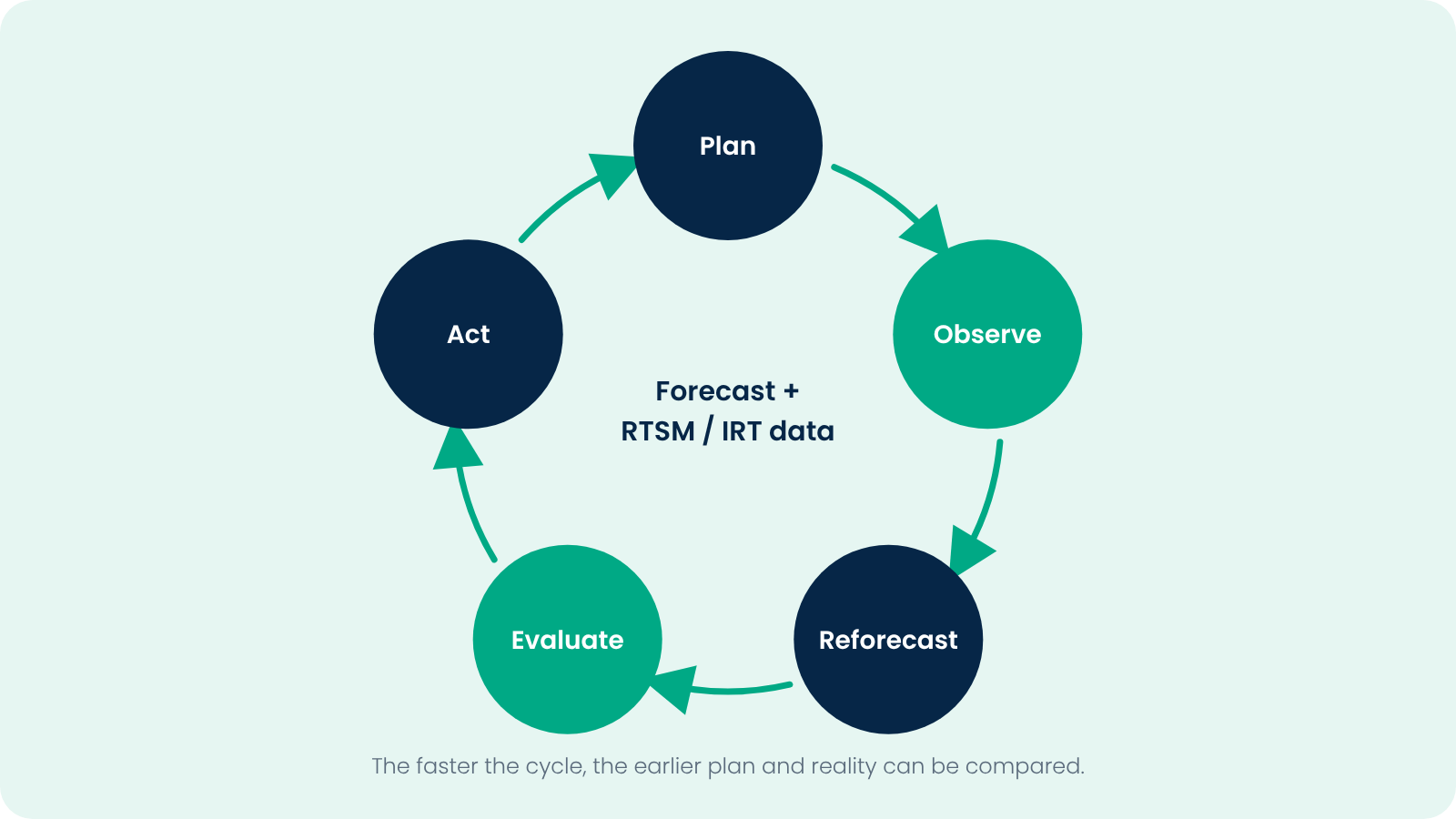
The faster that cycle operates, the earlier the team can identify divergence between plan and reality.
That doesn't remove uncertainty.
It makes uncertainty much more manageable.
Best-practice forecasting is ultimately about better decisions
There will never be a perfect clinical supply forecast.
Nor should that be the objective.
The real question is whether the forecasting process gives the supply team enough visibility to make good decisions before an emerging risk becomes an operational problem.
For us, best practice therefore means being able to:
Model uncertainty rather than hide it.
Compare scenarios rather than rely on a single plan.
Balance supply assurance against waste and cost.
Reforecast quickly when circumstances change.
Use real study data to continuously improve the plan.
When those capabilities come together, forecasting becomes much more than calculating how much product a study might need.
It becomes a decision-making capability for managing clinical supply risk throughout the life of the trial.
And that is ultimately where better forecasting creates value: helping ensure the right product is available for the right patient, while giving supply teams the information they need to make better decisions along the way.
Want to see how this works on your own studies? Discover Trialzen FPS or talk to us.
Frequently asked questions
What is best practice in clinical supply forecasting?
It means modelling uncertainty rather than hiding it, comparing scenarios rather than relying on a single plan, balancing supply assurance against waste and cost, reforecasting quickly when circumstances change, and using real study data to continuously improve the plan.
Why is a single baseline forecast not enough?
Recruitment rates, site activation dates, country mix, screening failure, dropout, treatment duration, titration rates and dosing all influence demand, and none of them is completely predictable. A baseline remains important, but it is the starting point rather than the answer.
When should a clinical supply forecast be updated?
Whenever reality changes: recruitment shifts, sites open late, countries are added, protocols are amended or expiry dates move. The update has to be fast enough that the options it reveals are still available.
How does RTSM/IRT data improve the forecast?
Actual recruitment, randomisation, dispensing and inventory data show how the study is really behaving. Feeding that into the forecast lets the team spot divergence between plan and reality earlier.